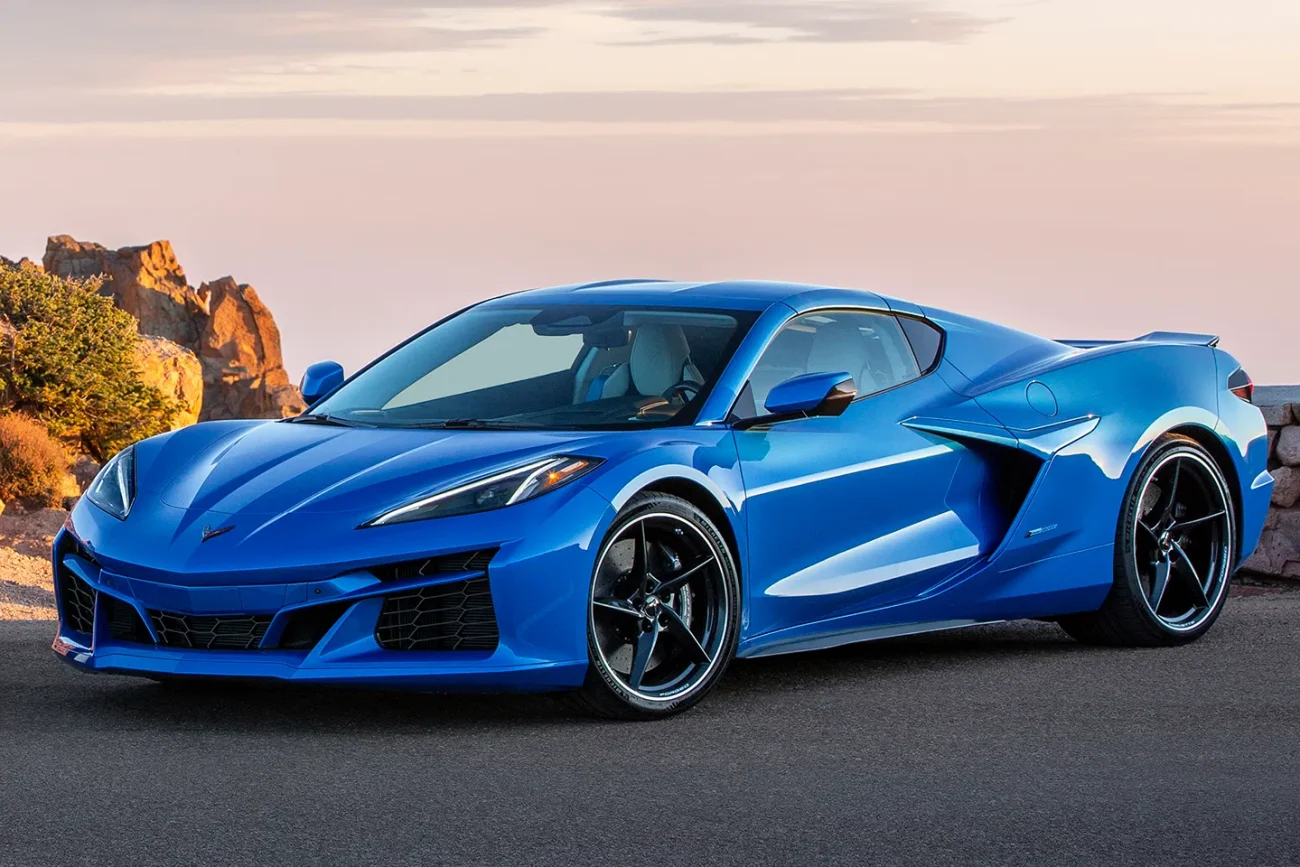
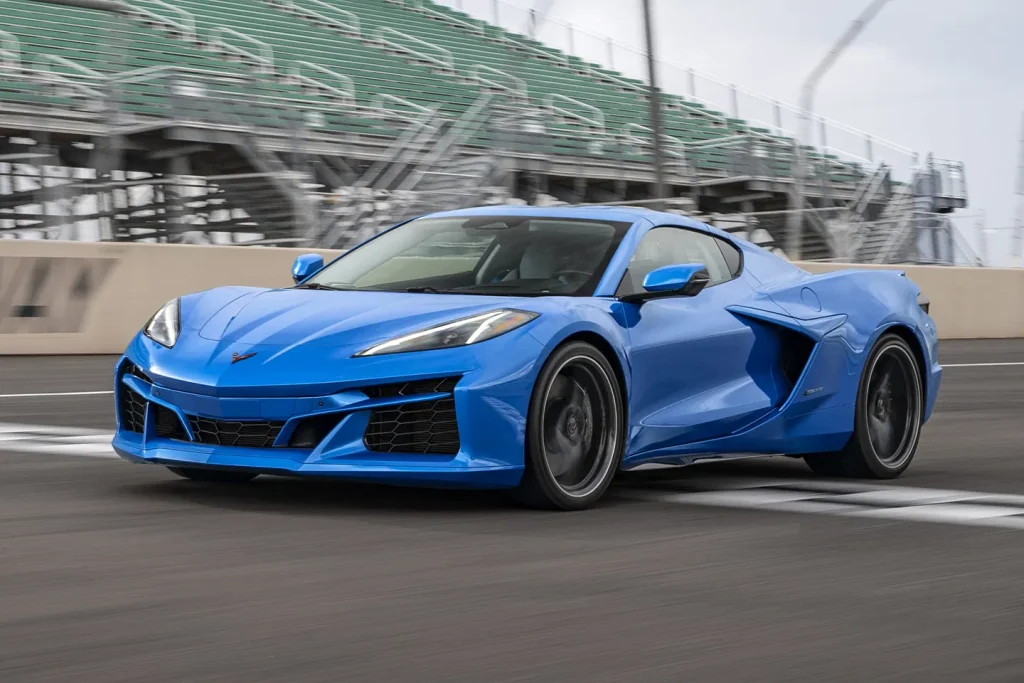
The Chevrolet Corvette E-Ray gives the feeling that something truly special is happening beneath the surface. There will be plenty of opportunities to fully understand the technical details of how this first-ever hybrid Corvette works, but what stands out immediately is how naturally everything comes together. The addition of the electrically powered front axle has completely changed the driving experience, in much the same way the move to a mid-engine layout transformed the Corvette lineup back in 2019.
This new setup makes the E-Ray feel smarter, more capable, and surprisingly confidence-inspiring. On normal roads, the changes are subtle but noticeable. On the track, however, the transformation becomes dramatic.
The real magic appears when the car is pushed close to its limits. In previous Corvette models like the Stingray or the track-focused Z06, reaching the edge of grip usually meant the rear end would start to slide, signaling most drivers to ease off immediately. Those cars never really encouraged playful drifting or exploring beyond the limit unless the driver was highly experienced.
The E-Ray feels completely different.
As the rear begins to lose grip, the front electric motor starts working harder, pulling the car forward and helping maintain balance. Instead of feeling nervous or unpredictable, the oversteer arrives in a smooth and controlled way. Even in the more aggressive driving modes, the stability system quietly works in the background, allowing the driver to enjoy the car’s playful character without feeling out of control.
What makes the experience even more impressive is how manageable the car remains when all the electronic aids are turned off. In most cars producing 655 horsepower and weighing around 1,800kg, that would normally feel intimidating. But in the E-Ray, the loss of traction happens so progressively that it almost feels slowed down, giving the driver time to react naturally.
The result is incredibly addictive. During one session at California’s challenging Thunderhill Raceway, the E-Ray delivered more enjoyable and controllable oversteer moments than almost every other Corvette combined. It transforms the driving experience from simply fast to genuinely thrilling and engaging.
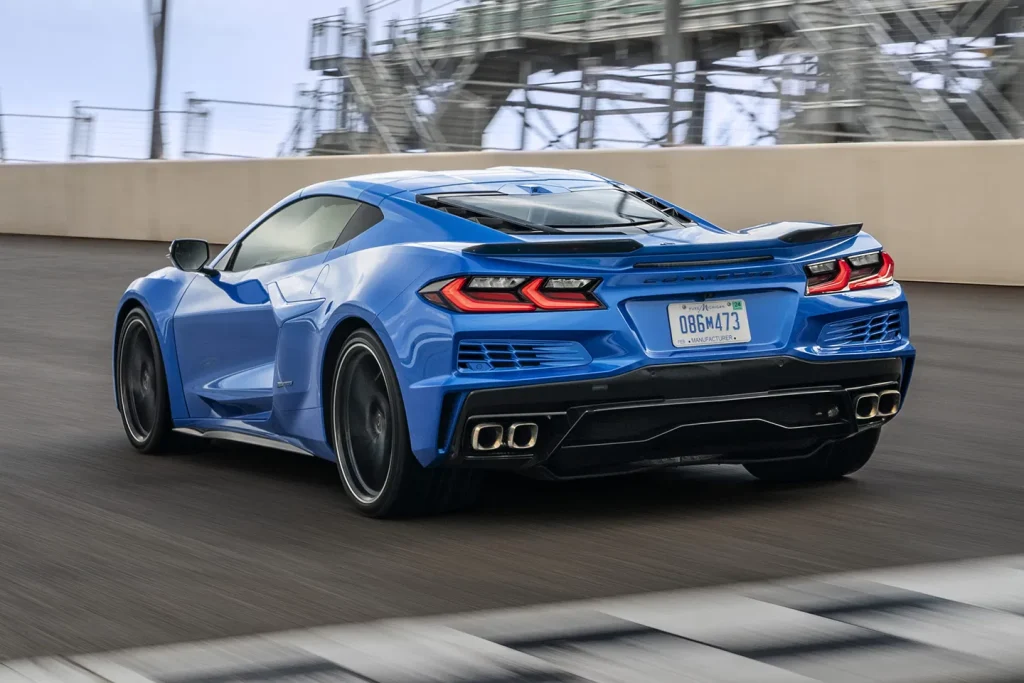
The ability to slide the Corvette E-Ray through corners in a controlled way was never the main reason Chevrolet created this car, and honestly, most owners probably won’t spend their weekends trying to drift it around a racetrack. But what those moments do show is just how perfectly the petrol engine and electric system work together.
The E-Ray uses a split hybrid setup, meaning the gasoline engine powers one axle while the electric motor powers the other. This idea itself is not completely new. Cars like the BMW i8 experimented with a similar concept almost a decade ago, although in a much less powerful form. The difference is that Chevrolet has refined the formula so well that the system feels seamless, natural, and incredibly effective.
What surprises many people when looking at the E-Ray’s specifications is how much of the original Corvette remains untouched. Sitting behind the cabin is the same 495-horsepower LT2 V8 engine found in the standard Corvette Stingray. It still sends power to the rear wheels through the familiar eight-speed dual-clutch transmission.
The major addition comes at the front, where Chevrolet installed a single electric motor producing 160 horsepower and 125 lb-ft of torque. This motor gets its energy from a compact 1.1kWh battery pack positioned between the seats. Even with the hybrid components added, the E-Ray only gains around 105kg compared to the regular Stingray, which is impressively light considering the extra technology.
Unlike many modern hybrids, the E-Ray is not a plug-in hybrid. Its electric-only driving capability is very limited, offering less than five miles of range. Chevrolet clearly did not design this car to behave like an electric commuter vehicle.
Instead, the electric system is focused mainly on improving performance and refinement. The car’s “Stealth Mode” allows quiet electric-only driving at speeds up to 45mph, which is ideal for leaving home early in the morning without waking the neighbors.
At higher speeds, the electric motor continues assisting the V8 until around 150mph. Beyond that point, the Corvette relies entirely on its powerful combustion engine to reach its top speed of approximately 180mph. The result is a hybrid system that enhances the driving experience without taking away the raw personality people expect from a Corvette.
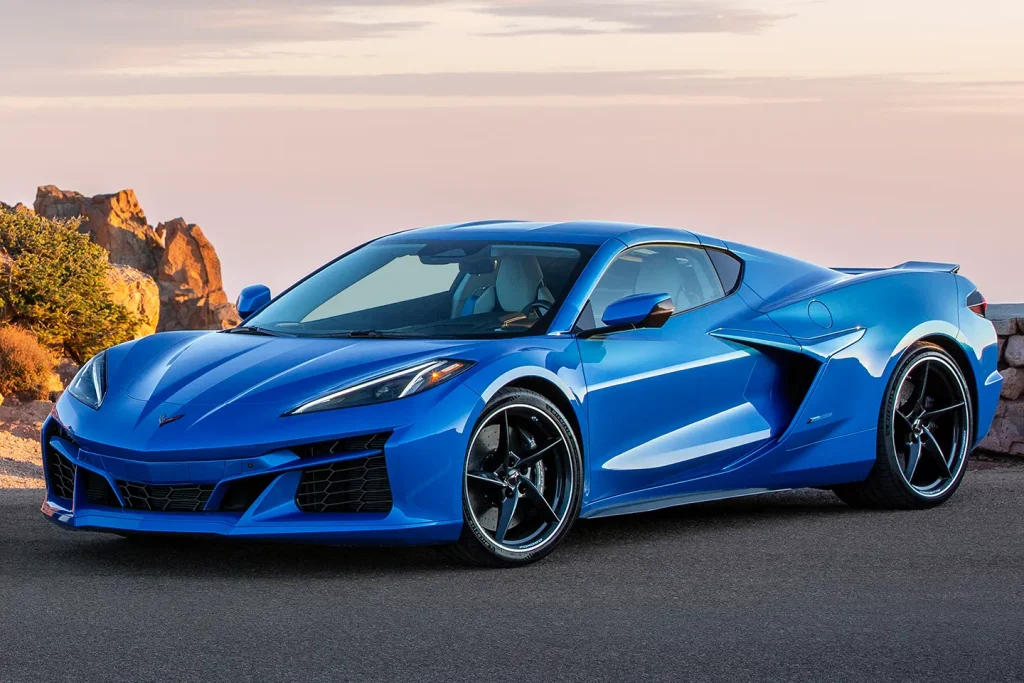
The Corvette E-Ray uses the same wide and aggressive body design as the Corvette Z06, making it noticeably broader than the standard Stingray. The car is around 90mm wider, mainly to fit its massive performance tyres, which instantly give it a more muscular and exotic appearance.
At the rear, the E-Ray rides on huge 345-section tyres wrapped around 21-inch wheels. These tyres are even more extreme in profile than the ones used on the new Lamborghini Revuelto. Up front, the 275-section tyres are also incredibly wide, giving the car enormous grip and stability.
Chevrolet expects many buyers to use the E-Ray all year round, even during colder weather, so the car comes standard with Michelin Pilot Sport all-season tyres. However, the test cars were fitted with the optional Michelin Pilot Sport 4S summer tyres, along with lightweight carbon-fibre wheels for even sharper performance.
Carbon-ceramic brakes are included as standard on every E-Ray, adding serious stopping power to match the car’s acceleration.
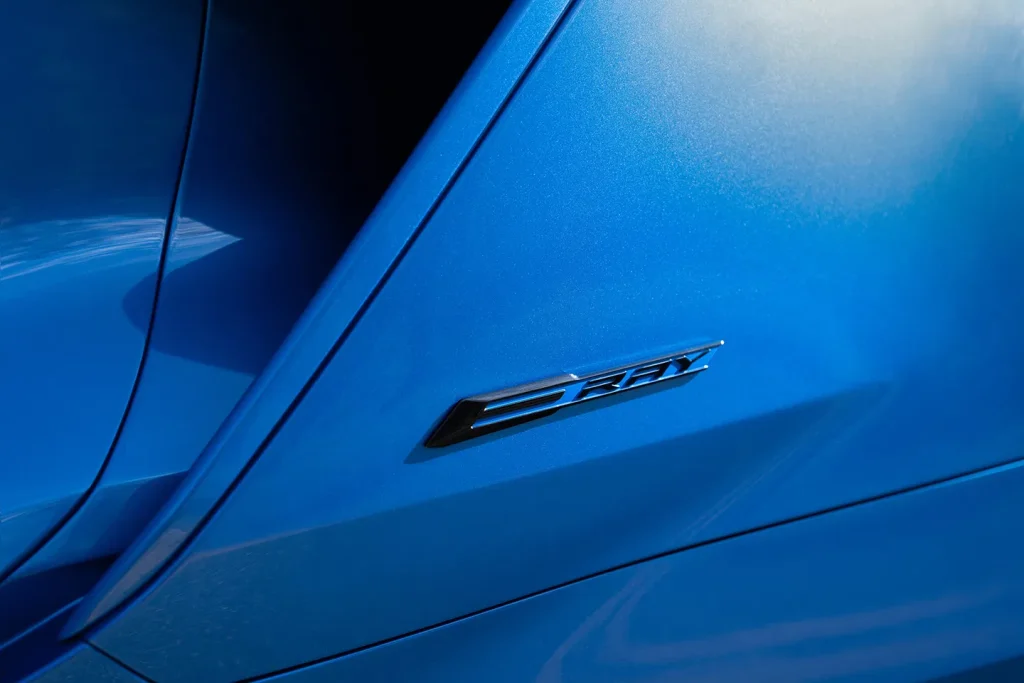
Despite all these upgrades, the E-Ray still looks surprisingly subtle. Apart from the small E-Ray badges behind the doors, most people would simply mistake it for a very well-equipped C8 Corvette. Chevrolet also managed to keep the practical storage areas, including the small front trunk and the rear compartment behind the engine that is large enough to fit golf bags.
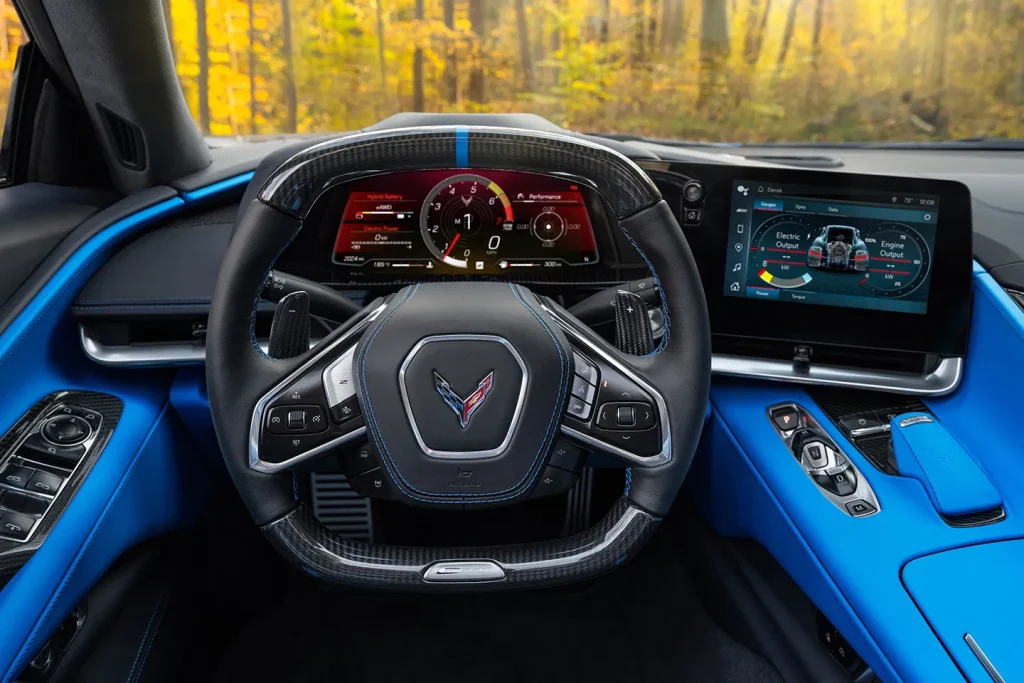
Inside the cabin, the story is much the same. The interior remains very close to the standard Corvette, meaning some of the familiar quirks are still present. The seating position feels slightly too high, and the large leather-covered center console still divides the driver and passenger in an unusual way. The long row of tiny buttons placed along the console can also feel awkward to reach.
The gear selector and circular drive-mode dial are unchanged, while activating the new Stealth Mode is slightly inconvenient. Drivers need to switch the ignition to its first stage without actually starting the engine, which feels more complicated than it probably should.
Chevrolet has added some new graphics and displays to the digital instrument cluster, including a feature that shows how much torque is being sent to the front wheels in real time. One of the few noticeable physical changes is a small button near the driver’s right knee that activates “Charge Plus” mode.
When the car is driven in Track mode or the customizable Z mode, the battery automatically uses its stored energy to deliver maximum performance. Activating Charge Plus allows the system to quickly recharge the battery, often in under three minutes or during a normal cooldown lap on the track.
Drivers can also keep Charge Plus activated while driving aggressively. In this mode, the electric system delivers slightly less peak power, but the battery drains more slowly, allowing consistent performance for up to 30 minutes of hard driving. The trade-off is that lap times become around four percent slower, but the car remains strong and reliable for longer sessions.
Apart from the fun of watching the battery gauge constantly rise and fall, there is not much need to use Charge Plus mode during normal road driving. In everyday conditions, chances to keep the throttle fully pressed for long periods are rare, especially on public roads filled with traffic, speed limits, and corners.
During relaxed driving, the E-Ray mostly relies on its V8 engine alone. But the moment the driver presses harder on the accelerator, the electric motor instantly joins in to provide extra power. Chevrolet even added a futuristic electronic sound through the front speakers to let drivers know the electric system is working. Thankfully, the sound is subtle and well-balanced, adding character without trying to overpower the deep and natural roar of the V8 engine sitting behind the cabin.
The 6,500rpm redline may feel slightly limited when compared to the high-revving 8,500rpm engine in the Corvette Z06, but the E-Ray still feels brutally fast in a very effortless way.
On regular roads, the E-Ray behaves more like an upgraded Stingray rather than a softened Z06. Its standard adaptive suspension delivers a surprisingly comfortable ride in Tour mode, making long-distance driving far more refined than most people would expect from a 655-horsepower sports car.
The steering is very quick and responsive, although at normal road speeds it does not provide a huge amount of feedback. Under hard acceleration on rough roads, there are moments when you can slightly feel the front wheels helping deliver power. However, the biggest advantage of the all-wheel-drive system becomes obvious in corners, where the E-Ray feels incredibly stable and confident before launching out of turns with impressive grip and very little drama.
Despite its agility, the Corvette still feels physically large on narrower roads, especially since visibility around the edges of the car is not perfect from the driver’s seat. Even so, it changes direction with far more precision and balance than a car of this size should realistically manage.
The E-Ray truly comes alive on a racetrack.
As speeds increase, almost every part of the car seems to improve. The steering gains more feel and accuracy as greater forces pass through the front tyres, remaining predictable even when the car begins to slide slightly. The brake pedal, which already feels solid on the road, becomes even more confidence-inspiring under heavy braking.
Although the car’s weight is noticeable when slowing down from very high speeds, the standard carbon-ceramic brakes handle extreme heat and repeated hard use without showing any signs of weakness.
Performance is simply astonishing. Using launch control on the track, the E-Ray managed to hit 0–60mph in just 2.4 seconds. Independent testing in the United States has also shown that it is only around a tenth of a second slower than the track-focused Corvette Z06 in the quarter-mile sprint, which is remarkable considering the E-Ray’s added comfort and hybrid technology.
There are several different ways to understand the appeal of the Corvette E-Ray, and that is exactly what makes it such an interesting car.
For some drivers, the biggest attraction will simply be the fact that this is the first all-wheel-drive Corvette. Unlike traditional rear-wheel-drive Corvettes that often stay parked during snowy winters, the E-Ray is designed to offer year-round usability, even in tougher weather conditions common in places like the American Midwest.
For others, especially younger buyers that Chevrolet hopes to attract, the E-Ray represents something much bigger. It feels like a modern, high-tech evolution of the Corvette — a sports car that combines traditional V8 excitement with advanced hybrid engineering in a surprisingly intelligent way.
No matter how buyers look at it, the E-Ray also delivers strong value for money. In the United States, the starting price of around $106,595 makes it significantly cheaper than many exotic performance cars with similar speed and technology. It costs roughly $20,000 less than a basic Porsche 911 Carrera 4, less than half the price of a McLaren Artura, and under one-third the cost of a Ferrari 296 GTB. That makes the E-Ray feel like a genuine supercar bargain in today’s market.
What may be even more exciting, however, is the possibility that the E-Ray is only the beginning of Corvette’s hybrid future.
Reports suggest Chevrolet could eventually combine this electric front-axle system with a twin-turbo version of the Corvette Z06’s flat-plane crank V8 engine to create an even more extreme model, currently rumored to be called the “Zora.” If those rumors become reality, the result could be a Corvette producing close to 1,000 horsepower with all-wheel drive capability — essentially Chevrolet’s answer to hyper-performance machines like the Ferrari SF90 and Lamborghini Revuelto.
And honestly, that is a very exciting thought for performance car fans.
Chevrolet Corvette E-Ray Specifications
| Specification | Details |
|---|---|
| Engine | 6.2L V8 Hybrid |
| Battery | 1.1kWh |
| Electric Motor | Front Axle Motor |
| Transmission | 8-Speed Dual-Clutch |
| Drive System | AWD Hybrid Setup |
| Total Power | 655 HP |
| Total Torque | 595 lb-ft |
| 0–60 MPH | 2.5 Seconds |
| Top Speed | 180 MPH |
| Weight | 1,712kg |
| Starting Price | $106,595 |
